Miner GO!
- 4.5
- Rating
- 50.00K
- Installs
- Free
- Price

 Analysis by App-foxy
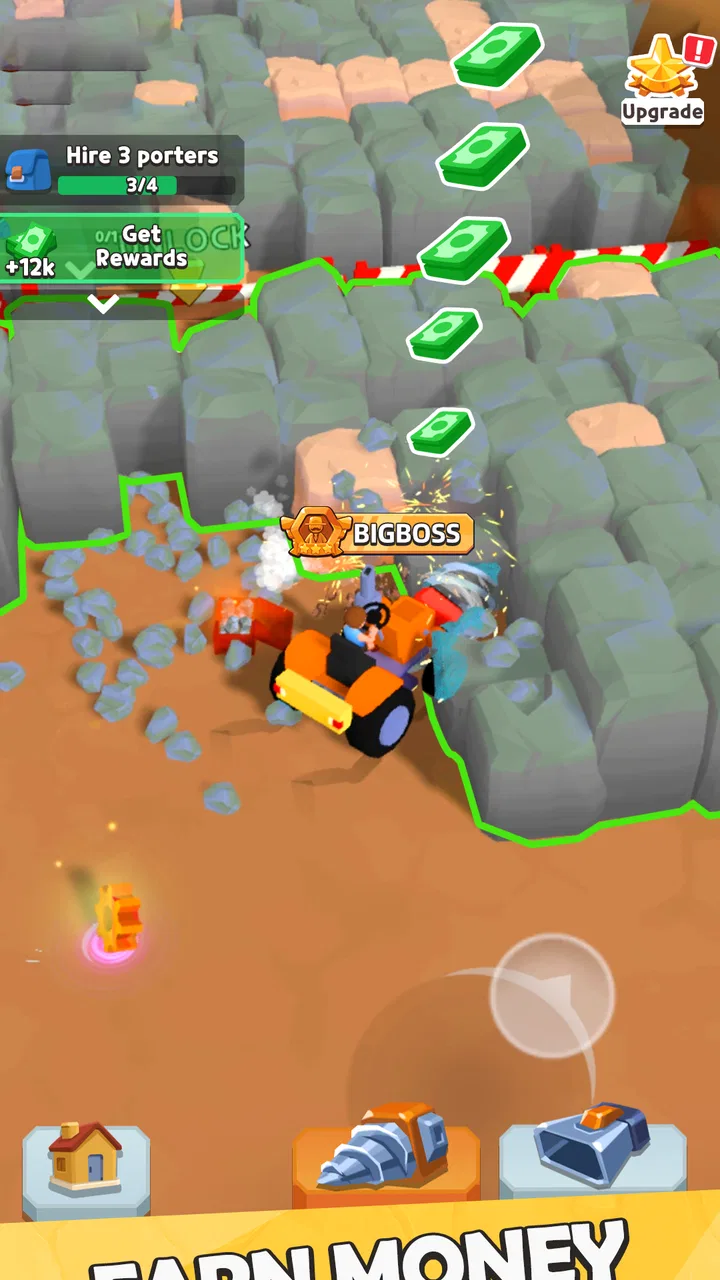
I spent time with Miner GO! as a compact arcade mining game, paying particular attention to how easy it is to understand, control, and return to during ordinary daily breaks. Its basic appeal is immediate: you operate a mining rig, collect resources, sell what you gather, and use the proceeds to improve your operation. That loop is simple enough to grasp quickly, but it also gives each short session a clear purpose instead of feeling like a collection of disconnected taps.
Developed by Seikami, the game is free to start and aimed at Everyone. It is available for Android devices running at least version 7.1, which makes it approachable for people using older compatible phones as well as newer hardware. The current version is 0.1.3, and the game has already passed 10K+ installs. Its average rating is 4.6 from around 387 ratings, with around 57 written reviews, so there is a modest but positive player response behind it.
How Miner GO! handles clarity, control, and different playing situations
I find clarity, control, and context matter as much as the mining loop itself: a game can be easy to understand yet still feel awkward on a particular phone or during a particular kind of break. I’d judge it by whether its simple decisions remain comfortable and worthwhile in your own routine, then consider the situations where that focused design works best.
You May Also Like

 Pandora - Music & Podcasts
Pandora’s Music Is Easy to Start, but Harder to Recover
Pandora’s strength is its low-effort path from a seed to a station. Its weak spot is how much confidence it asks you to place in connection, setup, and quiet recovery.

 8 Ball Pool
 Is Built on Rivalries, Rematches, and Routine
A close look at the rivalries, rematches, shared routines, and unanswered safety questions that turn a quick pool match into a persistent mobile community.

 Samsung Music
’s Quiet Strength Is Playing What You Already Own
Its reach comes less from spectacle than from dependable access to a personal library. That simplicity is both the app’s strongest retention engine and its ceiling.

 AccuWeather: Weather Radar
AccuWeather Review: A Quick, Clear Forecast for Everyday Decisions
For everyday plans, the best forecast is the one you can understand quickly. AccuWeather makes rain timing, radar, and local conditions easy to act on, with a few trade-offs.

 Hill Climb Racing
Why Hill Climb Racing Still Turns Crashes Into One More Run
A tiny car, a bumpy hill and one more upgrade: Hill Climb Racing keeps resurfacing because its simple chaos makes every near-miss feel personal.

 AliExpress - Shopping App
AliExpress Makes Global Shopping Feel Personal, but Shoppers Bear the Risk
AliExpress turns a global marketplace into a pocket-sized discovery engine. Its reach is useful, its shopping loop compelling, and its trade-offs easy to miss.
More From Our News Desk
View All News


Readable progression without a crowded first impression
The strongest part of the design is the direct relationship between action and reward. Mining produces resources, selling turns those resources into progress, and upgrades make the next round feel more worthwhile. I never had to decode a complicated genre before understanding what I was supposed to do. For anyone who prefers games with a visible short-term objective, that clarity is useful.
This matters especially for players who find dense menus tiring. A mining game can easily become a wall of currencies, upgrade branches, timers, and small icons. Miner GO! feels more approachable because its central idea remains easy to repeat: work the rig, cash out, improve it. I could return after a break and remember the basic rhythm without needing to reread a long tutorial.
The visual and navigational experience is best suited to players who are comfortable interpreting a compact mobile interface. The important decisions are tied to the mining and upgrade cycle, rather than hidden behind a large number of unrelated systems. That keeps the cognitive load lower than in many management games, although players who need very large text or strong visual separation may still find a small-screen arcade layout demanding.
I also like that the game’s progression gives a natural order to its menus. Instead of asking me to optimize everything immediately, it encourages a practical sequence: gather first, sell next, then decide where improvement is most useful. That sequence is a subtle accessibility advantage because it reduces the number of decisions competing for attention at the same time.
Why the simple loop works for short sessions
My most realistic use case was playing during small gaps in the day: a few minutes while waiting for an appointment, during a coffee break, or before putting my phone away at night. The game suits this pattern because a single activity has a clear beginning and end. I can make progress without committing to a long story chapter or a multiplayer match that expects me to stay available.
That does not mean every session feels identical. The meaningful choice is what to do with the resources after mining. Selling immediately gives a straightforward sense of completion, while holding back for a better upgrade can make the next decision more deliberate. I found that this creates a small but useful trade-off: quick satisfaction now versus a stronger future run.
A helpful personal habit is to decide what the next upgrade is before starting another mining cycle. That prevents aimless activity and makes the game easier to follow if concentration is limited. Instead of repeatedly tapping through the same actions, I can play toward a specific improvement and stop once I reach it.
Motor demands and the feel of repeated interaction
As an arcade game, Miner GO! depends on repeated interaction rather than long-form reading or precise virtual movement. That is good news for players who prefer uncomplicated controls, but it also means the game may be less comfortable for anyone affected by repetitive tapping, hand fatigue, tremors, or difficulty maintaining a steady grip. The mining loop is easy to understand; the physical repetition may be the more important consideration.
I would approach it in short bursts if repeated input is uncomfortable. The upgrade structure supports that style because progress can be divided into small goals. Playing for a shorter period and stopping after a sale or upgrade feels more manageable than trying to force a long session.
One non-obvious trade-off is that simplicity does not automatically mean low effort. A game with only a few core actions can still demand frequent attention if the player wants to improve efficiently. Miner GO! is accessible at the level of rules, but not necessarily effortless for every hand or every playing style. Someone looking for a mostly passive idle experience may prefer a game that handles more of the routine automatically.
Players who use a phone one-handed should also think about their device size and grip. The game is designed for mobile play, yet the comfort of reaching controls depends on the handset and the player’s preferred hold. I found it more pleasant when I kept sessions brief and avoided trying to play while walking or carrying something else. That is ordinary practical advice, but it makes a noticeable difference with any game built around repeated screen interaction.
Visual and sensory comfort in everyday use
The mining theme gives the game a focused visual identity, but arcade presentation can still be demanding for people sensitive to movement, flashes, or constantly changing screen elements. I would test it in a calm setting first rather than assuming that a simple resource game will be visually easy for everyone. The game’s rules are uncomplicated, but sensory comfort varies more than the store summary can suggest.
Sound is another situational factor. I often prefer to play mobile games with audio reduced or muted when I am in a shared space, such as a waiting room or public transport. Miner GO! works as a visual activity in those circumstances because the resource loop is understandable without needing a conversation or a story delivered through sound. This makes it more flexible than games whose main information arrives through spoken dialogue or audio cues.
For players who rely on audio to understand a game, the opposite question matters: whether visual feedback is sufficiently clear on their particular phone. I would not choose Miner GO! as an accessibility-first title for someone who needs every important state communicated through sound. Its appeal is primarily visual and interactive, so individual testing remains important.
When the game fits better than larger arcade alternatives
Compared with action-heavy arcade games, Miner GO! is less dependent on reflexes, rapid movement, and split-second reactions. That makes it a better match for me when I want a calmer arcade experience with a management flavor. I can think about the next upgrade instead of chasing a high score under constant pressure.
Compared with full management or simulation games, it is easier to enter and easier to leave. There is less need to maintain a large operation, monitor many categories, or remember a long chain of dependencies. The compromise is depth. Players who enjoy detailed production planning, complex economies, or extensive customization may find the mining loop too narrow after the initial novelty fades.
It also occupies a different space from traditional idle games. The resource cycle gives it an active arcade identity rather than making progress feel entirely automatic. That is a strength if I want my decisions to matter during a session. It is a weakness if my ideal game is something I can check once in a while with almost no interaction.
In other words, the best audience is not simply “people who like mining.” It is players who enjoy a clear repeatable loop, modest strategic choices, and progress that can be handled in short visits. Someone seeking a story-driven adventure, a competitive leaderboard challenge, or a deep industrial simulator should look elsewhere.
Useful habits for making the loop easier to manage
The first practical tip is to treat selling as a decision point rather than an automatic conclusion. If I sell whenever possible, the game feels quick and tidy. If I pause to consider the next upgrade, I get more control over the pace. This is a small distinction, but it changes the experience from repetitive tapping into a lightweight planning exercise.
The second is to use upgrades as session markers. Instead of measuring a play session by time, I can measure it by one completed improvement. That approach is helpful for players with limited attention, unpredictable schedules, or a preference for clearly bounded activities. It also reduces the temptation to continue playing simply because the next reward is close.
The third is to avoid judging the game only by its first few minutes. The basic loop is intentionally straightforward, so its appeal depends on whether the gradual improvement feels satisfying to you. I recommend trying several short sessions and paying attention to whether choosing upgrades remains interesting. If the decision-making already feels repetitive, more time is unlikely to solve that personal mismatch.
There is also a financial consideration. Miner GO! is free, with in-app purchases priced at $4.99 per item. That makes trying the core game low-risk, but players who are sensitive to purchase prompts should decide in advance whether they want to spend anything. I prefer treating purchases as optional rather than part of the basic evaluation: first see whether mining, selling, and upgrading are enjoyable without paying, then decide whether an item adds enough value for your own play style.
Situational access: where it works and where it does not
The game is a good companion for waiting rooms, short commutes when seated, and quiet breaks at home. It does not require the social coordination of a multiplayer game, and its central loop can be paused mentally between sessions. That makes it less disruptive for people whose day is divided into unpredictable fragments.
It is less suitable when your attention must remain on the environment. I would not play while crossing streets, cycling, cooking, or handling anything that requires both hands. The controls may be simple, but the game still asks you to look at the screen and make repeated inputs. A simple game is not automatically a safe distraction in every context.
Battery, screen size, and device comfort can also affect the experience. Older compatible phones may run the game, but the physical quality of play still depends on how comfortably the interface fits on the screen and how long the device can be held. For someone with a compact phone and limited hand fatigue, short sessions may be ideal. For someone using a large handset or needing substantial visual magnification, the practical experience may be less comfortable.
Barriers that remain despite the friendly concept
The largest barrier is repetition. The game’s strength is its focused loop, but that same focus can become monotonous for players who need frequent changes in scenery or mechanics. There is no point pretending that selling and upgrading will satisfy everyone indefinitely. The right question is whether the incremental improvement feels rewarding enough to justify repeating the cycle.
Another barrier is the limited room for players who want extensive control over accessibility preferences. I would not approach this as a title with specialized accessibility tools or a broad set of clearly advertised customization options. Instead, its inclusiveness comes mainly from the uncomplicated premise and flexible session length. That can help many casual players, but it is not a substitute for adjustable text, high-contrast modes, remappable controls, or other dedicated options when those are essential.
The Everyone age rating makes the game suitable for a broad audience, but age suitability and physical accessibility are different things. A child, an older player, and someone with a motor impairment may all understand the rules while having very different experiences with screen interaction. Families should still watch how comfortably each person handles the repeated controls rather than assuming the age label answers every practical question.
Finally, the early version number is worth keeping in mind. With the current version at 0.1.3, I see Miner GO! as a focused game whose long-term appeal will depend on how well its progression continues to hold attention. I would recommend it for the loop it offers now, not on the assumption that future additions will change its scope.
My inclusive verdict on Miner GO!
I recommend Miner GO! to players who want a free arcade game that is easy to understand, comfortable in short sessions, and built around a satisfying sequence of collecting, selling, and improving. Its clearest inclusive strength is that it does not bury the player under complicated instructions before the first meaningful action. The game also works well for people who prefer visual, self-paced progress over reflex-heavy arcade pressure.
I would be more cautious if you need specialized accessibility settings, find repeated tapping painful, rely heavily on audio feedback, or want deep simulation systems. In those cases, a game with stronger customization, more automation, or a broader management layer may be a better choice. The same applies if you want a rich narrative or constant mechanical variety.
For me, the best way to approach it is as a small, focused routine rather than an all-day game. Set a modest upgrade goal, play in a comfortable seated situation, keep the sound appropriate for the environment, and stop when the session stops feeling relaxed. Miner GO! is at its best when its simplicity gives you control over the pace, not when you expect it to replace a much deeper arcade or management game.
FAQs for Miner GO!
01What is Miner GO! and how does it work?
Miner GO! is an engaging mobile game where players embark on mining adventures to extract valuable resources. Players navigate through various levels, using tools to mine and avoid obstacles. The gameplay involves strategic planning and quick reflexes to maximize resource collection and progress through increasingly challenging stages.
02Is Miner GO! free to play, or are there in-app purchases?
Miner GO! is free to download and play, offering an enjoyable experience without any initial cost. However, it does include optional in-app purchases. These purchases can enhance gameplay by providing additional tools, resources, or cosmetic items to enrich your gaming experience and facilitate quicker progression.
03What devices and platforms are compatible with Miner GO!?
Miner GO! is available on both Android and iOS platforms, making it accessible to a wide range of users. It is compatible with most smartphones and tablets running the latest operating systems. Ensure your device meets the minimum OS requirements for optimal performance and a smooth gaming experience.
04How does Miner GO! ensure player safety and privacy?
Miner GO! prioritizes player safety and privacy by adhering to strict data protection policies. The app collects minimal personal information necessary for gameplay and ensures that any data collected is securely stored. It also provides parental controls and safety settings to protect younger players.
05What are the main features that set Miner GO! apart from other mining games?
Miner GO! distinguishes itself with its vibrant graphics, engaging storyline, and diverse range of tools and upgrades. The game offers unique challenges and events to keep players engaged. Its social features, like leaderboards and multiplayer modes, encourage interaction and competition among friends and other players globally.
Pros
- Engaging gameplay with strategic elements.
- Vibrant graphics and smooth animations.
- Regular updates with new levels.
- Offline mode available for on-the-go play.
- User-friendly interface for easy navigation.
Cons
- In-app purchases can be pricey.
- Occasional ads interrupt gameplay.
- Limited character customization options.
- Requires frequent internet connection.
- Some levels feel repetitive over time.

Miner GO!
Gallery